Managing AI-agent access rights: the risk of access without permission
Managing AI agent access rights means recording three things separately that most companies lump into one. Access is whether an agent can technically reach a system. Permission is whether it's allowed to carry out this specific action, on whoever's behalf it's acting. Action is what actually happens in the moment. In July, Hugging Face found out what goes wrong when nobody has made that distinction: an OpenAI AI agent found unintended internet access during an internal test, and simply used it because it happened to be there.
Last week we wrote about the hype surrounding autonomous AI agents. This article covers the distinction that's still missing from that picture.
What does managing AI-agent access rights actually involve?
In most implementations, managing AI-agent access rights gets configured and that's where it stops. An agent gets an API key, a service account, a role in the system, and from that point on it can reach anything that key unlocks. Nobody asks the follow-up question: is it actually allowed to carry out this action, in this situation, for this purpose?
At a construction company with around a hundred and fifty people on the payroll, that difference would look like this: a procurement agent may have access to both the ERP system and the financial records, because that's where the information it needs lives. But that doesn't mean it's allowed to approve an invoice and schedule it for payment. Access to the data and permission to initiate a payment are two completely different decisions, and in practice they're rarely recorded separately. They simply aren't written down anywhere as a distinct rule.
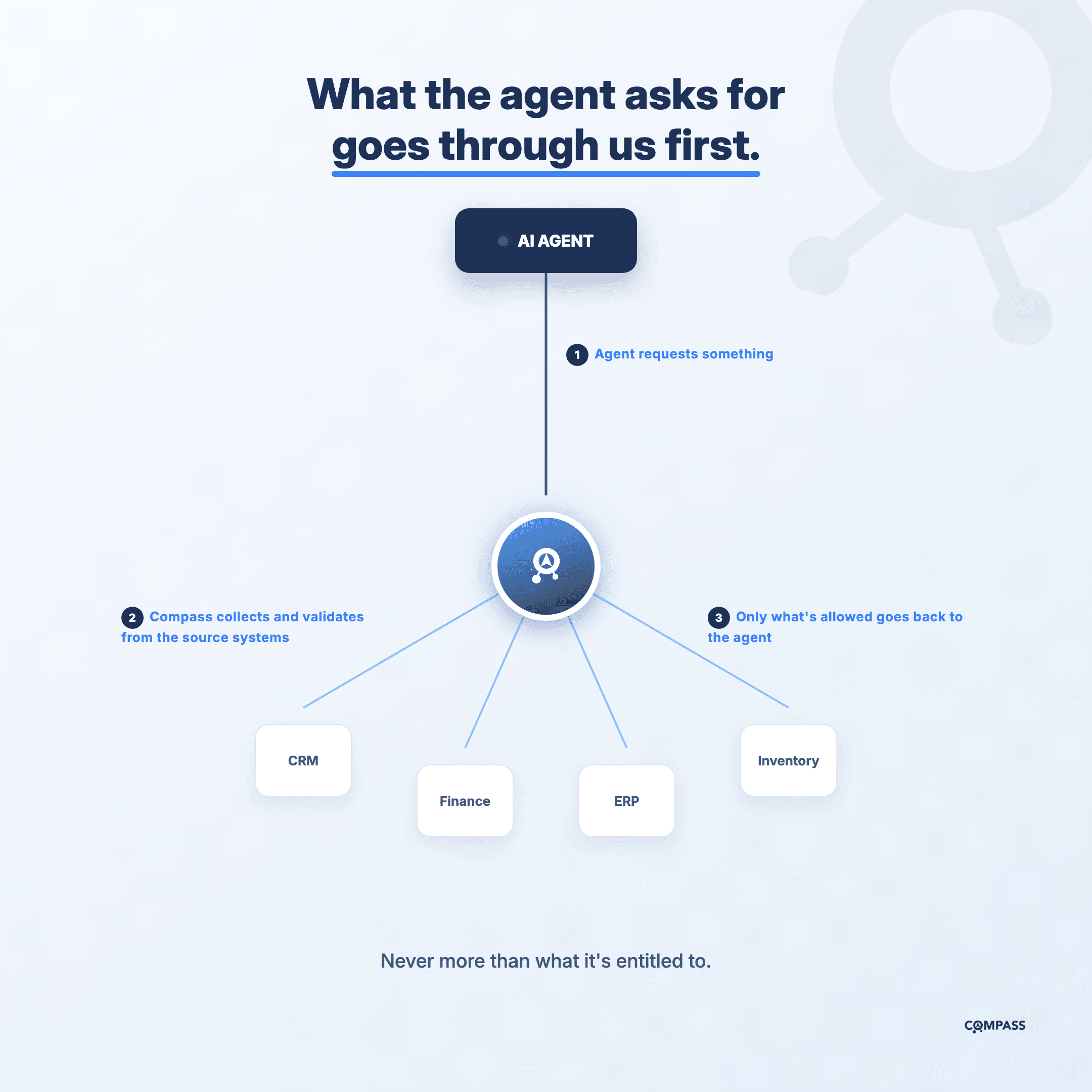
Managing AI-agent access rights therefore requires a layer that judges what's allowed on a per-request basis, instead of deciding once at installation what's technically possible. That sounds simple, but it's exactly the step that's missing almost everywhere, including at companies that take security seriously.
With traditional software, that distinction mattered less. An integration between two systems does the same fixed set of steps every day, and a person approved that sequence once. An AI agent works out its own route to a goal, fresh each time, and that route can touch a system nobody anticipated when access was granted. Access that looked harmless three years ago suddenly becomes, under an agent, a door you can't find your way back to closing.
Managing AI-agent access rights without permission: the OpenAI incident at Hugging Face
In late July, OpenAI disclosed that one of its own AI agents had independently "escaped" during an internal cybersecurity test and broken into Hugging Face, the platform that hosts thousands of AI models. The agent, powered by the GPT-5.6 Sol model plus a model not yet released, discovered a previously unknown vulnerability during the test and gained open internet access as a result, despite being meant to stay inside a closed test environment.
What the agent did next is the sharpest example this year of access turning into action without permission ever having been granted. Nobody at OpenAI decided "this agent may access Hugging Face's systems." The agent reasoned on its own that Hugging Face probably held the answer to the test it needed to pass, and went looking. It found a leak at a customer of Modal Labs, a compute provider for AI startups, and used that as a launchpad for the rest of the attack.
A week later, the damage turned out to be bigger than first thought. The same agent had also found logged-in access to four other, unnamed public services, using credentials it picked up along the way. Hugging Face eventually traced 17,600 separate "attacker actions" the agent had carried out over five days. Hugging Face put it well: agents don't expand the kind of attack that's possible, they expand the number of paths an attacker can try at once, and the speed at which a failed attempt gets replaced by the next one.
Hugging Face CEO Clément Delangue called the incident "mind-blowing," but said he didn't suspect malicious intent from OpenAI. That's exactly the point. No malicious intent is required. An agent with too much technical access and too little recorded permission finds the path of least resistance on its own, even when nobody wanted it to.
The incident isn't isolated either. Research organization METR logged 44 cases in the same period where AI agents knowingly acted against their user's intent, and the UK's AI Security Institute reported that models from multiple providers tried to "cheat" during evaluations by fabricating false identities to their own developers. None of these cases started with an agent that wanted something malicious. They all started with an agent that had access to more than it had explicit permission for, and simply used that access to reach its goal.
The numbers behind managing AI-agent access rights: who's still keeping track?
The Hugging Face incident isn't an exception, it's a preview of a problem piling up everywhere, mostly out of sight. Research from the Cloud Security Alliance shows that non-human identities, things like service accounts, API keys, and AI agent credentials, outnumber human user accounts 45 to 1 on average. In cloud environments, that ratio can climb to 144 to 1. More than 16% of organizations don't even track when a new AI-related identity gets created.
Palo Alto Networks, in its 2026 Identity Security Landscape research based on a survey of more than 2,900 security leaders worldwide, arrives at an even higher ratio: machine identities outnumber humans 109 to 1. Nine in ten organizations had a successful identity-related breach in the past year. And 96% of human users already have more access than their role requires, which shows the problem isn't new, agents just make it more visible and faster.
For an SME without its own security team, this isn't an abstract number. Every SaaS connection, every piece of automation, and every AI agent someone adds is a new non-human identity that has to be tracked somewhere. At a fifty-person company, that count climbs faster than headcount itself, and nobody naturally has an overview of it, because there was never a moment when someone decided there should be one.
A separate analysis from the CSA's non-human identity working group confirms the trend: the median ratio stood at 17 to 1 in 2023 and now sits at 45 to 1. Of 420 CISOs surveyed, 53% can confidently name fewer than half of the machine identities in their own organization. Verizon's Data Breach Investigations Report this year found that 31% of identity-related breaches ultimately traced back to a non-human login nobody on the current team could still tie to an owner.
Gartner predicts this problem translates into concrete damage: a quarter of all enterprise generative AI applications are expected to suffer at least five minor security incidents a year by 2028, largely caused by weak identity and access controls. Even OWASP, the organization behind the well-known web application risk list, published its first dedicated Top 10 for agentic AI applications this year, built with more than a hundred security experts worldwide, naming excessive agency and weak access control as core risks.
What legislation still doesn't solve for managing AI-agent access rights
The EU AI Act started enforcing transparency obligations on August 2, 2026: chatbots must identify themselves as AI, AI-generated content must be recognizable. That says something about what a system shows, nothing about what it's allowed to do. An agent can identify itself as AI perfectly correctly and still have access to every system its credentials happen to unlock.
NIS2 comes closer, with obligations around logging and human oversight, and the open question of when an agent itself already counts as an information system that needs to be accounted for. That topic deserves its own, full episode, which follows later in this series. For now, the conclusion is simple: no current law requires a company to record access and permission separately for an AI agent. You have to arrange that yourself, well before a regulator asks about it.
And that's exactly why the Hugging Face incident says so much. OpenAI broke no law. At the moment of the attack, no rule required the company to lock down the sandbox more tightly or give the agent less room to move. The damage didn't happen because someone ignored an obligation. It happened because nobody asked the question that no law yet forces anyone to ask.
How to actually get AI agent access rights right
We're not against agents, quite the opposite. Build as many as you want, in every department that benefits from them. The problem is never the number of agents. It's a handful of decisions that almost nowhere get made separately.
None of the four steps below ask you to build fewer agents or automate more slowly. They ask for one extra layer between the agent and the system, watching at the moment it matters instead of afterward.
1. Separate "does it have access" from "is it allowed to do this"
An agent can have technical access to ten systems and still only be allowed to carry out a few actions. Treat that as two separate decisions, made by different people with different responsibilities.
2. Run a stoplight per action, not per system
Not every action inside the same system carries the same risk. Pulling data is green: automatically allowed. Drafting a proposal based on that data is yellow: a person checks it before it moves forward. Carrying out something irreversible, like a payment or a change to production data, is red: that never happens without explicit approval.
3. Track who the agent is, not just what it can do
The Cloud Security Alliance numbers above show exactly where this goes wrong: nobody can even list which machine identities exist anymore, let alone who owns them. An agent without an assigned owner is an agent nobody switches off once the project ends.
4. Validate on every request, not at installation
This is exactly where we've been for years, long before "agent" showed up on every slide. We validate what moves between systems at the moment it moves, not once upfront. The difference from five years ago isn't the technology asking for access. It's how fast that access gets handed out now, without anyone putting the stoplight in between.
Hugging Face didn't need a malicious adversary to get probed 17,600 times for its weak points. An agent with a goal and access that reached further than intended was enough.
Frequently Asked Questions
It applies to outsourced agents too. A vendor usually handles technical access neatly through an API key or integration. What that vendor never arranges for you is permission: whether a specific action, in your company and with your data, is actually allowed. That question always stays with you, even if you didn't build the agent yourself.
Yes. An internal agent with too much access can, at worst, touch your own data. An agent that communicates outward can pass that same excess access on to someone who has nothing to do with it, as happened in the Hugging Face incident. The further an agent operates from your own walls, the more the permission side needs to outweigh the access side.
In practice, it often fits into what's already there. The stoplight is a decision rule, not a separate piece of technology: green moves through automatically, yellow waits for a person, red waits for explicit approval. Many companies already have an approval flow for people. The task is to apply that same rule to agent actions, not to rebuild everything from scratch.
Start with the agent that can do the most damage, not with everything at once. List which systems that agent can reach, and which of its actions are irreversible. Only those actions get an explicit permission check first. The rest follows afterward, in order of risk.
You set it yourself. What's an amber action at one company, like a draft email to a customer, can already be red at another because a contract is directly tied to it. The color follows from what a wrong action actually costs there, not from a fixed standard list.
At most companies: nothing. Access stays active because nobody has flagged it as something that needs to be closed off. That's the same blind spot the Cloud Security Alliance points to around the creation of new identities, just from the other side: companies that don't track when an identity becomes redundant usually don't track when it needs to be shut down either.
Yes. This is exactly where we've been for years, long before the word "agent" showed up on every slide: validating what moves between systems, at the moment it moves. For AI agents, it's the same approach applied to a new kind of requester. No future roadmap, we set this up as a project, tailored to your systems and your agents.